Home vs. Gym: How to Maintain Your Gains When You Can’t Hit the Squat Rack

Many fitness enthusiasts wonder how to maintain muscle gains when they can’t hit the gym regularly
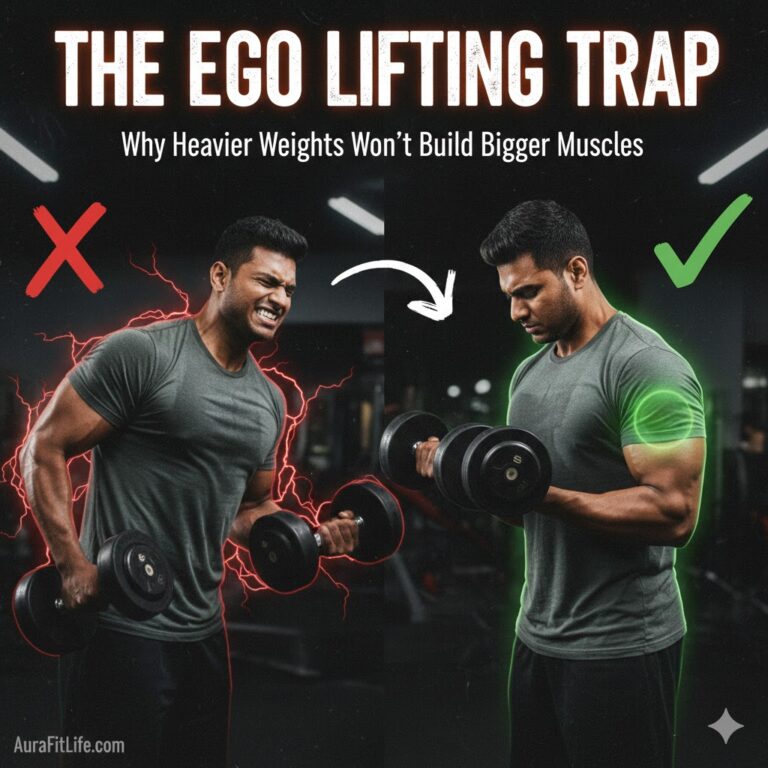
It happens to the best of us. Sometimes the workload at the office becomes unbearable, family commitments take priority, or you find yourself in a location where there isn’t a squat rack or a bench press for miles. For a dedicated fitness enthusiast, this feels like a nightmare. The first question that pops into our heads is: “Will months of hard work vanish in just a few days?” I am here to tell you absolutely not. Muscle loss doesn’t happen nearly as fast as people fear. In fact, if you have moved past The Ego Lifting Trap and learned how to actually stimulate your muscles rather than just moving heavy weight, you can maintain your physique perfectly at home.
The Science of Muscle Retention: How Long Does It Take to Lose Gains?

Let’s look at the science first to calm your nerves. The human body is incredibly efficient. Research shows that actual “atrophy” (muscle loss) doesn’t typically begin until about 2 to 3 weeks of total inactivity. However, if you are performing “Maintenance Training,” you can hold onto your gains for months.
While building muscle might require 10–12 hard sets per muscle group per week, maintaining it only requires about 1/3 of that volume provided the intensity remains high. This means a workout that took you an hour at the gym can be condensed into a 20-minute high-intensity home session with similar retention results. It’s all about “Intensity,” not “Volume.”
1. Progressive Overload Without Plates: Get Creative at Home

In the gym, we measure progress by adding “plates.” It’s easy to add 5 lbs to a bar. At home, without equipment, we have to find new ways to increase “Mechanical Tension.”
- Tempo and Control: Most people do home pushups so fast they look like they’re running a race. This doesn’t build muscle. My personal tip: Take 4–5 seconds to go down (the eccentric phase) and hold for 2 seconds at the bottom. Suddenly, 10 reps feel harder than 50 fast ones.
- Using Leverage: If normal pushups feel too easy, elevate your feet on a bed or chair (Decline Pushups). This shifts the weight to your upper chest and shoulders. Similarly, master the “Pistol Squat” (single-leg squat) to double the resistance on your legs.
- Short Rest Periods: In the gym, we might rest 3 minutes between heavy sets. At home, cut your rest to 30–45 seconds. This increases metabolic stress, which is a key driver for keeping your muscles full and hard.
- The Ego Lifting Trap
2. My Personal Experience: The Backpack Strategy

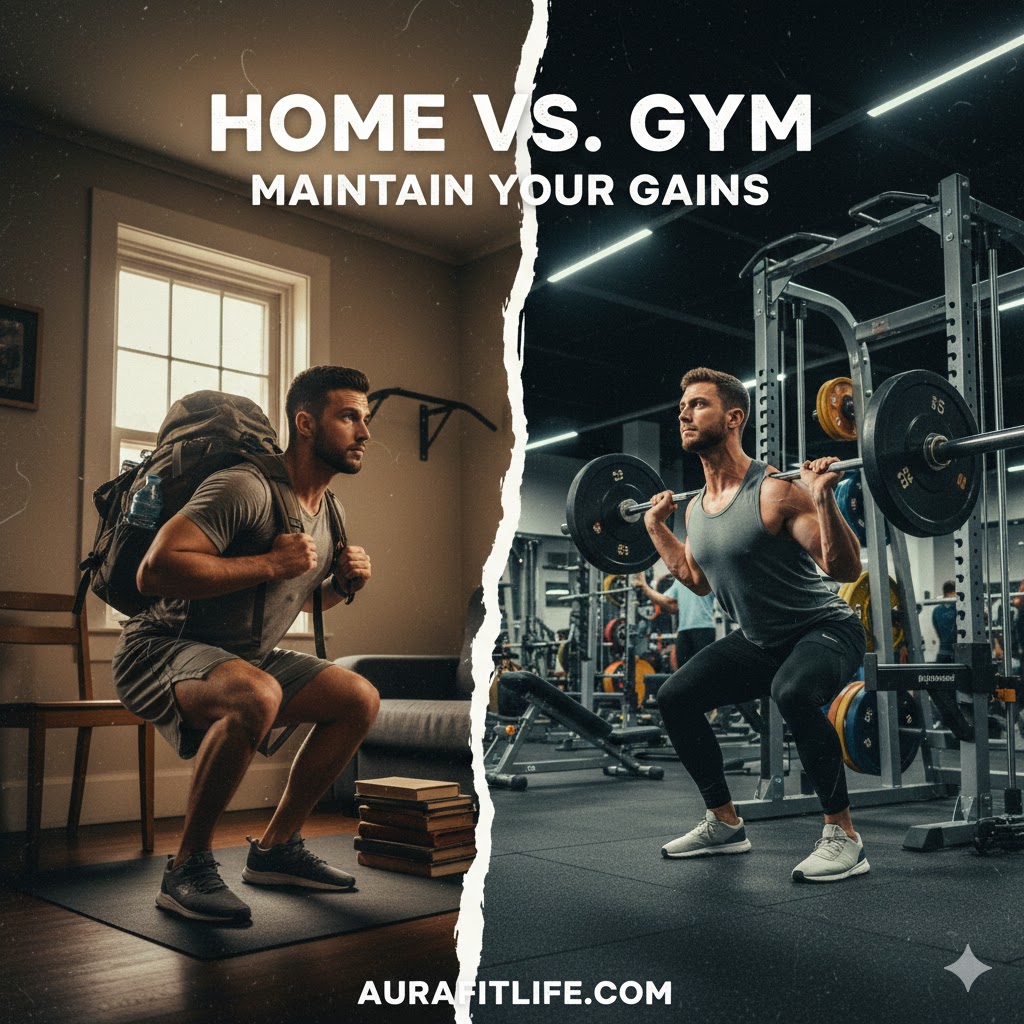
I remember two years ago, I was staying in a remote area with zero access to a gym. For the first two days, I was stressed. Then, I decided to try “Improvised Training.” I took my old travel backpack and stuffed it with 7-8 heavy books and two large water bottles.
I wore that bag and performed Bulgarian Split Squats (one leg elevated on a chair). Trust me, by the third set, my quads were screaming. I realized then that the muscle doesn’t know the difference between a $5,000 leg press machine and a backpack filled with old books; it only understands “resistance.” I trained like this for 21 days, and when I returned to the gym, I was actually stronger because my “stabilizer muscles” had improved so much from the bodyweight variations.
3. Nutrition: How to Eat Without the Gym

When training at home, people usually make two mistakes: they either overeat out of boredom or they stop eating protein because they think “I’m not lifting heavy anyway.”
Protein is your greatest weapon for muscle maintenance. When you aren’t lifting heavy weights, your body needs those amino acids even more to prevent muscle breakdown. https://en.wikipedia.org/wiki/Muscle_hypertrophy
- Keep Protein High: Ensure every meal has a protein source like eggs, chicken, or lentils.
- Adjust Your Carbs: Since your total energy expenditure is slightly lower than a heavy gym day, reduce your rice or bread intake by about 20% to avoid unwanted fat gain. For more detailed tips on managing your diet, check out our Nutrition & Diet category.
4. Recovery: View This as a “Deload” Phase

Many lifters suffer from “Gym Guilt.” They constantly worry they are shrinking. This stress releases “Cortisol,” a hormone that is actually detrimental to muscle mass.
Think of this phase as a “Blessing in Disguise.” Our joints (knees, elbows, shoulders) need a break from heavy loading. Bodyweight exercises allow your connective tissues to heal. When you eventually return to the squat rack after two weeks, your Central Nervous System (CNS) will be refreshed, and you’ll likely feel more explosive than before.
FAQs: Common Questions Every Fitness Enthusiast Asks
Q1. Can I really save my muscle mass with just pushups and squats? Ans: Absolutely. Pushups, Pull-ups, and Squats are “Compound Movements.” If you use variations (like diamond pushups or archer squats) and train close to failure, your body will have no reason to drop muscle.
Q2. How many days does it take for muscle to turn into fat? Ans: This is a huge myth. Muscle and fat are two entirely different tissues; one cannot turn into the other. However, if you stop working out and start eating junk, your muscle may shrink while fat increases, making it look like a transformation.
Q3. Do I still need supplements while working out at home? Ans: Supplements are only necessary if you aren’t hitting your targets through whole foods. Things like Whey protein or Creatine are still beneficial at home, but you can definitely maintain your gains with a solid natural diet alone.
Q4. How much time should I spend on a home workout? Ans: If your intensity is high, a 30 to 45-minute session is plenty. Focus on 4–5 exercises for 3–4 sets each, keeping the rest periods short.
Conclusion: Mindset Is Everything
In the end, remember that fitness is not a 100-meter sprint; it’s a marathon that lasts a lifetime. If you can’t get to the gym for a week or two, it’s not a failure. It’s an opportunity to master your bodyweight and improve your mobility.
Consistency is the ultimate key to success. A 20-minute home workout is infinitely better than the “Perfect Gym Session” that you never showed up for. So, stand up, fill that backpack, or just use the floor get your session in today!
Welcome to AuraFitLife! AuraFitLife is a wellness-focused platform providing informative content on fitness workouts, mental health awareness, and healthy living. Muhammad Azam follows ethical content guidelines and prioritizes accuracy, clarity, and reader value. We are committed to sharing practical, research-based information that supports healthier and more balanced lifestyles